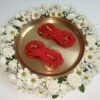
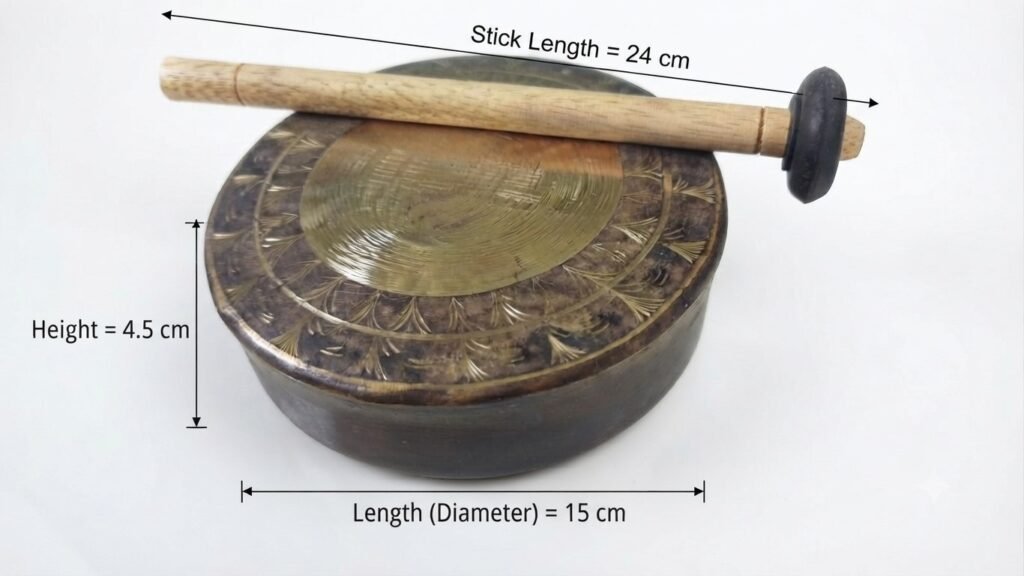
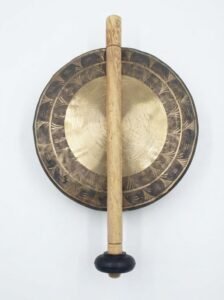
If you’ve ever stood in a temple during mangalarati, you know the moment. The lamp begins to circle before the deity, and beneath the chanting there’s this other sound — a low, ringing shimmer from a small bronze disc, struck again and again with a wooden striker. That sound is the Jangetta (also called Jagate or Jaagate), a traditional instrument central to Madhva sampradaya worship.
Most people experience it purely as ritual. But there’s something else going on in that sound worth talking about — something that connects an old temple tradition to a very modern conversation: using sound as an anchor for attention.
Sound as an Anchor: Not a New Idea
Long before “mindfulness apps” existed, cultures around the world built sound into the architecture of focused attention:
- Zen monasteries use a single bell strike to mark the beginning and end of meditation sittings.
- Tibetan practitioners use singing bowls, letting the sustained ring give the mind something steady to rest on.
- And in Madhva(Vaishnavas) tradition, the Jangetta’s ring accompanies the exact instant of arati — the moment attention is meant to be fully, wholly on the deity.
What all of these have in common isn’t a claim about “healing frequencies.” It’s something simpler and more defensible: a distinct, non-verbal sound gives the mind a single point to land on. When your attention wanders — which it constantly does, in worship, meditation, or daily life — a strong, recognizable sound cue is one of the easiest ways to gently pull it back.
Why the Jangetta’s Sound Works This Way
Bronze is the traditional and preferred material for ritual bells and gongs specifically because its molecular structure lets it ring longer and richer, producing the deep, layered resonance associated with sacred sound — unlike brass, which dampens quickly into a shorter, thinner tone.
The Jangetta isn’t musical in the melodic sense. Struck bronze doesn’t ring out in tidy, “pretty” notes — it produces a dense, shimmering wash of overtones that don’t resolve into a simple tune. That’s actually what makes it effective as an attention cue: it doesn’t sound like speech, background noise, or music you’d tune out. It cuts through. Your ear can’t help but notice it, and for a brief moment, everything else falls away.
Combine that with its natural sustain — the ring doesn’t stop the instant it’s struck, it decays slowly — and you get a sound that gives the mind something to follow, moment to moment, rather than just react to and dismiss.
This is why so many focus and meditation practices — old and new — reach for a struck resonant object rather than, say, a spoken instruction or a musical melody. The Jangetta belongs to that same family of tools.
Bringing It Into Your Own Practice
You don’t need a temple setting to use a Jangetta this way. A few simple approaches:
- Opening/closing cue — Strike it once before you begin a meditation, prayer, or focused work session, and once when you end it. This mirrors how it’s used in arati: marking a boundary around a moment of full attention.
- Return-to-breath anchor — If your mind wanders during meditation, a single strike (by you or a partner) gives you an audible cue to return to the present.
- Grounding ritual — Before a home pooja or personal reflection time, letting the Jangetta ring out and simply listening to it fade to silence is, in itself, a short exercise in sustained attention.
A Piece of Living Tradition
What makes the Jangetta special isn’t just its sound — it’s that this sound has been marking sacred, focused moments in Madhva households and temples for generations. When you bring one into your own space, you’re not just adding a decorative object. You’re adding a small, deliberate tool for presence — one that people have trusted for exactly that purpose for a very long time.
Benefits of the sound
- Helps create a meditative atmosphere
The long, resonant tone from bronze can provide a steady auditory focus. Listening to it may help you settle your attention during prayer or meditation. - May promote relaxation
Slowly decaying, harmonious sounds can be calming for some people. This is more about the overall acoustic experience than one particular frequency. - Useful as a ritual “attention cue”
In Hindu worship, bells and metal instruments are traditionally used at the beginning of puja. The sound can signal the transition from ordinary activities to prayer and focused awareness. Used especially by Vaishnava devotees during Maha mangalarathi in South India. - Rich harmonics from bronze
The bronze produces multiple resonances and harmonics. That complex sound is actually part of what gives a bronze vessel/bell its characteristic ringing quality. - Spiritual significance
Traditionally, temple bells and bronze sounds are associated with purification, invoking divine attention, and creating a sacred atmosphere. These are matters of religious tradition rather than scientifically established effects.
Where to Buy
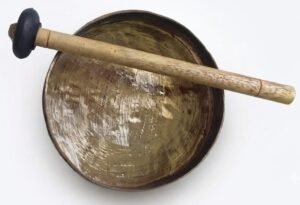
If you’d like to bring this simple, powerful sound tool into your own home practice, we’ve got you covered. Our handcrafted bronze Jangetta comes complete with the traditional wooden rubber striker — ready to use for aarti, puja, or your own daily moment of focus, right out of the box.
👉 Buy the Jangetta with Wooden Striker Here
Don’t just let it sit on a shelf — use it. Strike it before your next meditation, prayer, or focused work session, and let that ring mark your moment of presence. A small ritual, repeated daily, is how lasting habits of focus and stillness are built.
Available now at Raghavendra Stores — handcrafted, authentic, and ready to ship.